

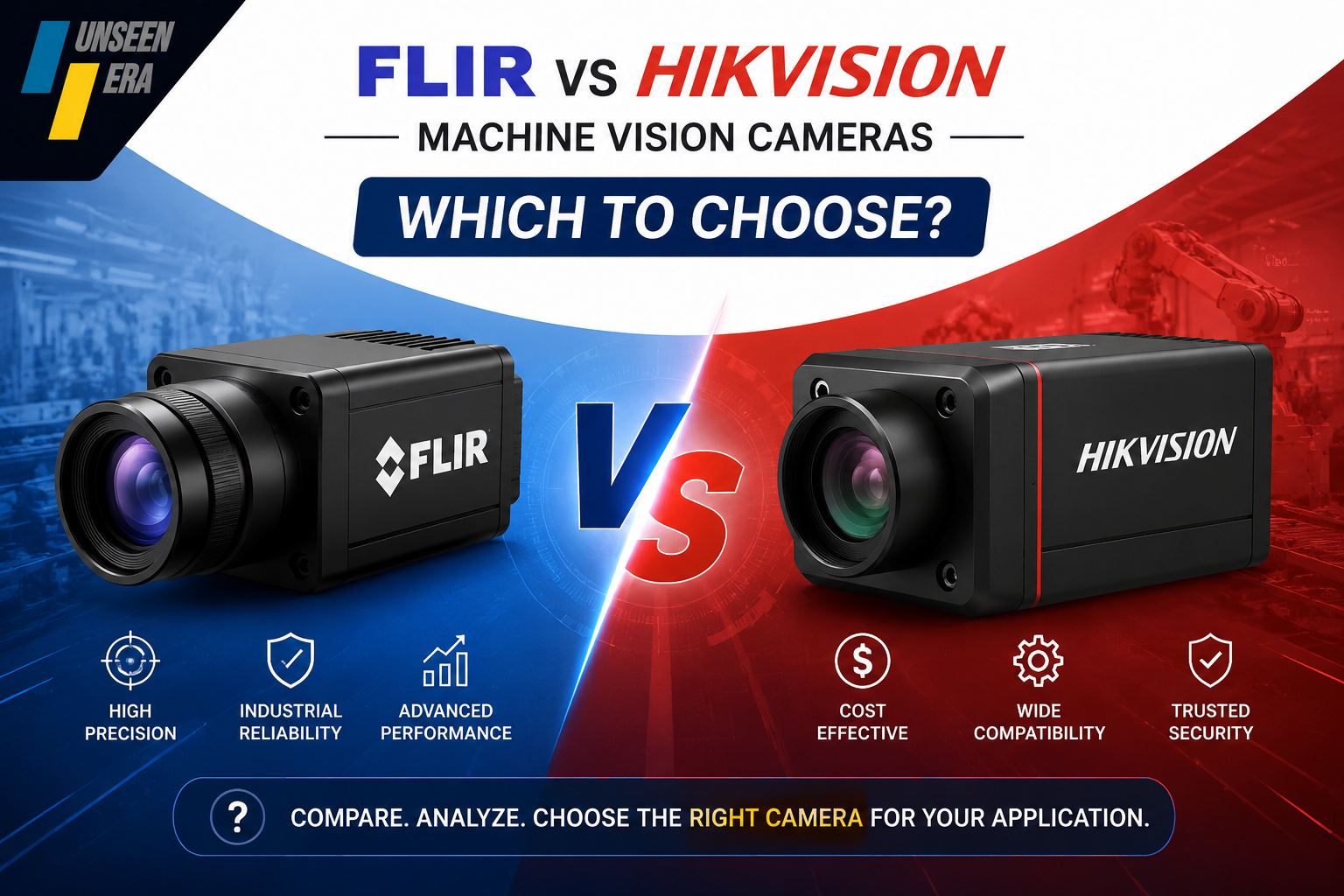
The performance, speed, and reliability of an industrial inspection system could vary based on the selection of the proper machine vision camera for the application. Automation is a critically developing industry and is important in manufacturing, electronics, automotive industries, packaging, and other fields business owners look for leading cameras brands before purchasing vision solutions. FLIR & Hikvision Machine Vision cameras are just 2 types of cameras that you could fit your application with, with both of their imaging and automation applications.
Which one will you have to pick between FLIR & Hikvision machine vision cameras? Various factors, including frame rate, system cost, image resolution, sensor, connecting methods, etc may be factored into the analysis. Even though FLIR cameras excel in imaging technologies and the machine vision field, Hikvision provides a wide scope of machine vision cameras for various applications.
This guide will compare FLIR vs Hikvision Machine vision cameras, analyzing each camera’s features, applications, merits, and restrictions, with expert support from Unseen Era Technologies, so you may learn how to pick the camera system that suits your specific requirements in your industrial vision solutions, whether they are newly built or an upgrade.
FLIR vs Hikvision Machine Vision Cameras: At a Glance
In a discussion of FLIR vs Hikvision machine vision cameras, each has strong offerings for industrial imaging, but their applications differ. FLIR’s expertise in imaging technology, for instance, lends itself to machine vision applications in areas requiring sophisticated imaging, high-accuracy inspection, automation, and specialized sensing capabilities. This brand provides valuable solutions for high-demand industrial scenarios, research purposes, quality control, and any environment needing detailed image data. For its part, Hikvision has an expansive range of cameras aimed at the machine vision market, serving purposes such as automated inspection and measurement, identification and production-line functionality.
Businesses are able to choose Hikvision’s vision cameras based on a number of criteria, including their sensor types, resolution and frame rate, alongside specific job requirements. Certain vision systems need a high-resolution camera if, for example, inspection of small defects in tiny components is needed, while high frame rate can be vital for production-line applications and fast-moving objects.
FLIR vs Hikvision: Key Differences
Choosing between FLIR and Hikvision machine vision cameras should be driven by your unique inspection and automation requirements and should not be based on brand names alone. Here is a rundown of the differences in cameras you should consider:
Imaging Technology: FLIR has a strong line of industrial imaging technology. This includes visible-light and thermal imaging systems. Hikvision largely concentrates on industrial machine vision cameras for obtaining,inspecting, measuring, and automating machine parts.
Image Quality: Different camera resolutions and camera sensor configurations are available from both manufacturers. FLIR may come in handy for applications involving highly specialized or very advanced imaging requirements, while Hikvision carries a diverse line of products for typical industrial inspection needs.
Resolution: The ideal camera resolution will be contingent upon the physical size of the object and the smallest possible imperfections to detect. While both suppliers carry multiple options for camera resolution, your business can choose the optimal resolution needed for your process.
Frame Rate: For businesses that operate at high-speed production, frame rate will be an important factor to assess. When selecting your Hikvision or FLIR camera model for high speed industrial automation, it is important that you take into consideration object speed, exposure time, as well as the number of images you will need to process per second.
Machine vision Applications: Common applications of Hikvision machine vision cameras include defect inspection, dimension testing, barcode detection, product recognition, robot control, and general automated quality control.
How to Choose the Right Machine Vision Camera for Your Application
Choosing the right machine vision camera for your inspection task is critical for enabling accurate inspection, reliable image processing, and consistently automated performance. Rather than making a choice based on brand and cost, an examination of the overall application and conditions where the camera will be deployed should take precedence.
Understand the Inspection Goal: Begin by determining precisely what the camera is meant to observe, gauge, identify, or inspect. Applications such as defect detection, dimensional gauging, barcode verification and robotic guidance.
Select Appropriate Resolution: Resolution requirements should be determined by the smallest feature or flaw that must be identified. Higher resolution levels provide improved clarity, but this comes at the expense of data handling and storage.
Determine the Correct Frame Rate: Objects moving at high speeds on a production line warrant an application requiring a camera with sufficient frame rate capacity that will not sacrifice clarity while also not missing any critical inspection points.
Select the Best Sensor Technology: Applications may demand selection between monochromatic, color, thermal, and other specialty imagers. Clear contrast-based inspection may lead toward application of a monochromatic camera, while color distinction tasks favor selection of a color camera.
Consider the Lighting Conditions: An excellent camera will not produce reliable results without illumination suitable to its parameters. Take into account the available ambient lighting, the degree of reflection and shadowing.
Ensure the Right Lens & Field of View: A camera lens is selected in accordance with an appropriate camera sensor and considering factors such as working distance, dimensions of the object, and intended field of view of application parameters.
Verify Connectivity Requirements: Inspect that the required image processing can connect to the vision camera’s communication protocol via GigE Vision, USB3 Vision, or appropriate other industrial interfaces.
Why Choose Unseen Era Technologies for Machine Vision Solutions?
Selecting an appropriate machine vision partner is just as important as choosing the camera. Unseen Era Technologies delivers industry vision and automation solutions centered on application, measurement, and production needs. They provide industrial machine vision cameras, smart vision sensors, custom vision systems, and various other industrial automation-related technologies covering application areas like automotive, pharmaceutics, electronics, food and beverage, and manufacturing, etc.
Application-oriented solution: Unseen Era believes in providing application-driven solutions and building vision systems around the production process; it does not consider a “one-size-fits-all” solution applicable for many applications.
Wide variety of vision technologies: From smart vision sensors, industry cameras, to GigE / USB machine vision cameras and inspection cameras, etc. Unseen Era could cater to various automation needs with suitable vision technologies
High speed inspection: The machine vision solutions could reduce or even replace traditional quality inspection methods, and assist factory automation in the inspections of parts’ defects at very high speed.
Accuracy inspection: Applications may require vision inspection solutions capable for surface inspection, dimensional measurement, presence/absence of parts, check for part assembly, barcode, OCR, defect check etc.
Easy for industrial integration: Vision products provided by Unseen Era supports various industrial communication options, enabling them to work well with your existing factory equipment and automation infrastructure.
Frequently Asked Questions (FAQs)
- What’s the difference between FLIR and Hikvision machine vision cameras?
FLIR and Hikvision are two leading manufacturers that provide machine vision cameras for industrial imaging and automation. While both can supply machines for such uses, they may have different product portfolios, imaging technologies, sensor options, software ecosystems, and strengths in specific application areas.
- Which is best, FLIR or Hikvision machine vision cameras?
FLIR might be a better choice for applications where specialized imaging requirements are key, while Hikvision can be ideal for a wide array of standard industrial inspection and automation tasks. Your decision should be influenced by resolution, frame rate, sensor type, connectivity, and budget.
- How do I select the right machine vision camera?
To select the right camera, you need to consider a number of factors including:
- The purpose of the inspection
- Required resolution
- Frame rate of the inspection system
- Sensor type (e.g., area scan, line scan, thermal)
- Field of view
- Required lens
- Overall system budget
- Are FLIR and Hikvision cameras appropriate for industrial automation?
Yes. Both FLIR and Hikvision offer machine vision cameras that are well-suited for various applications in industrial automation, including:
- Quality inspection and defect detection
- Precise measurement and metrology
- Barcode and QR code reading
- Robotics guidance
- Sorting and gaging
- What contributes to the cost of a machine vision camera system?
The total cost of a machine vision camera system extends beyond the initial price of the camera itself. It includes the camera specifications, resolution, sensor technology, the right lens, suitable illumination, appropriate cables, and the machine vision software.
- Can Unseen Era Technologies help decide between FLIR and Hikvision cameras?
Unseen Era Technologies works with companies to assess their machine vision needs, identify specific application requirements, and then recommend the optimal cameras, lenses, lighting, and software.



 Call
Call Whatsapp
 Contact Us